
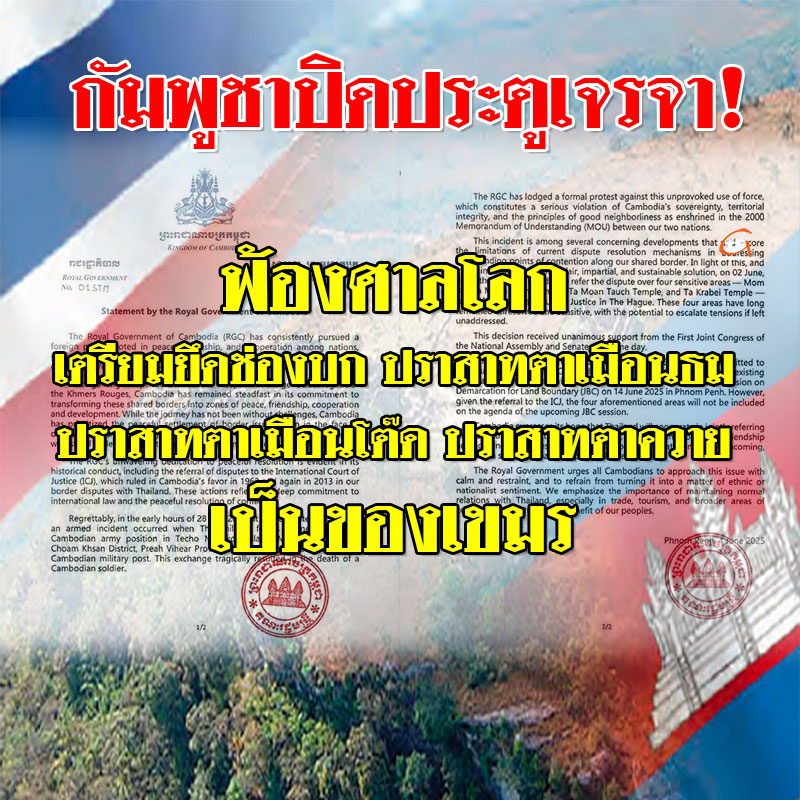
Cambodia has closed the door on negotiations! It issued a statement stating it will no longer hold Joint Border Committee (JBC) talks with Thailand and will file a lawsuit at the International Court of Justice, preparing to seize the Chong Bok pass, Ta Muen Thom Temple, Ta Muen Tod Temple, and Ta Kwai Temple as Cambodian property. Furthermore, it threatened Thailand, emphasizing the need for Thailand to be a good neighbor in order to build trust and long-term friendship. The statement concluded with Cambodia stating it will maintain relations with Thailand in the areas of trade and tourism.
Statement from the Cambodian government. The Cambodian government (RGC) consistently pursues a foreign policy committed to peace, friendship, and cooperation among all nations, especially with its neighbors sharing borders established during the French colonial period. Since gaining independence, with the exception of the Khmer Rouge genocide regime, Cambodia has remained steadfast in its commitment to transforming these shared borders into a zone of peace, friendship, cooperation, and development.Although the journey was fraught with challenges, Cambodia prioritized resolving its border issues peacefully, even in the face of tension and the tragic loss of life of our brave soldiers who stood in defense of national sovereignty and territorial integrity.
The RGC's unwavering commitment to peaceful resolution has been evidenced in past actions, including submitting disputes to the International Court of Justice (ICJ), which ruled against Cambodia in 1962, and again in 2013 in border disputes between Cambodia and Thailand. These actions reflect our deep commitment to international law and peaceful resolution.
Unfortunately, in the morning of May 28, 2025 at around 05.30 hrs. An armed incident occurred when Thai troops opened fire on a Cambodian military base at Techo Morocco Village, Moroccan Community, Jomkson District, Preah Vihear Province, an area that has long been recognized as a Cambodian military base. This exchange resulted in the tragic death of Cambodian soldiers.
The RGC filed a formal protest against the unprovoked use of force in violation of Cambodia's sovereignty, territorial integrity and principles of good neighbourhood as contained in the 2000 Memorandum of Understanding (MOU) between our two countries. This is one of several events of concern that underscore the limitations of current dispute resolution mechanisms in dealing with long-standing conflicts along our common borders.
For this reason, and in the interest of finding a fair, impartial, and sustainable solution, on June 2, 2025, the RGC decided to refer four sensitive disputes—the Chong Bok area, Ta Muen Thom Temple, Ta Muen Tod Temple, and Ta Kwai Temple—to the International Court of Justice in The Hague. These four issues have remained unresolved and are highly sensitive for a long time, and their absence could escalate tensions.
This decision was unanimously supported at the first joint session of the National Assembly and the Senate on the same day. . While the legal process at the International Court of Justice unfolds, the European Commission remains committed to negotiation and diplomacy. Cambodia will continue to engage through existing bilateral frameworks and will host the next meeting of the Joint Commission on Land Boundary Delimitation (JBC) on June 14, 2025, in Phnom Penh.
However, judging from the submissions to the International Court of Justice, the four issues mentioned above will not be included in the next JBC agenda. . Cambodia hopes that Thailand will cooperate in submitting this case to the International Court of Justice, taking into account justice, building trust, long-term friendship and good neighbourhood.
However, if cooperation is not possible, Cambodia is prepared to act independently. . The government urges all Cambodians to resolve the issues with peace and tolerance, and not to let them become a matter of nationalism or patriotism. We emphasize the importance of maintaining normal relations with Thailand, especially in trade, tourism, and broader cooperation, for the mutual benefit of our people.
