
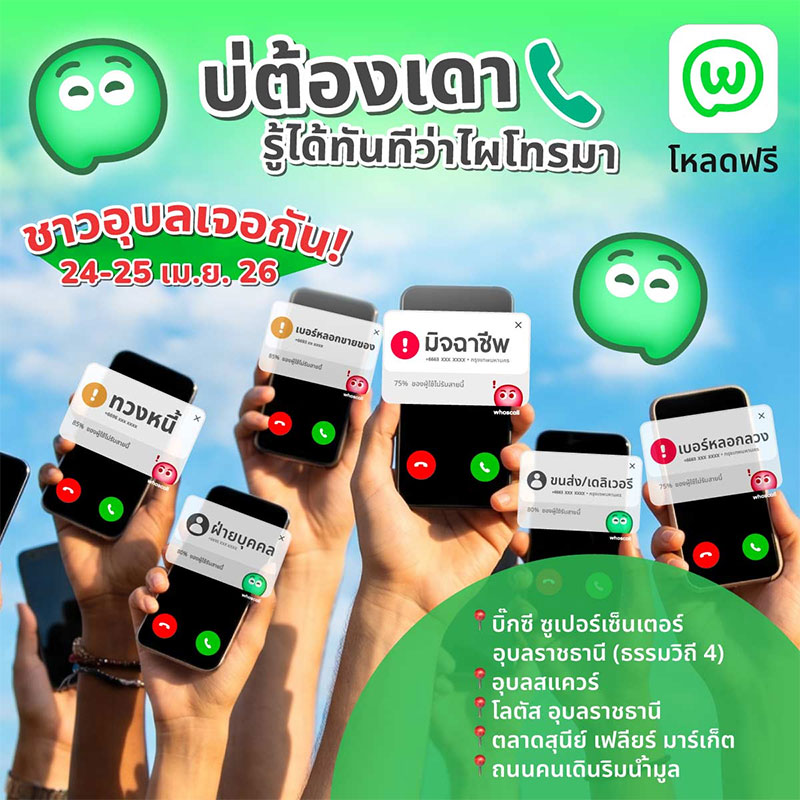
April 24, 2026 - Gogolook, a Whoscall application service provider and leader in TrustTech, co-founded by Jeff Gua, CEO and co-founder, and Man Wooju, CEO, Gogoluk Thailand, moves to fully upgrade digital security to the Northeast to address the confidence crisis, launching the “Whoscall: Don't Guess… Know It Now” campaign to create a shield against cyber threats and bridge the gap.technology to ensure that the Northeastern brothers and sisters receive all the fraudulent, fraudulent, Thai calls from the annual report Whoscall 2568 to 173 million times, the most in Asia.

Thai Fraud Crisis: The Latest Situation in 2025
The annual report for 2025 clearly indicates that Thailand has been targeted by more fraudulent scammers compared to other countries in Asia. Despite the intensification of law enforcement and cross-border cooperation in the region, statistics reveal that scammers made 39 million fraudulent calls to Thai people and 134 million fraudulent SMS messages, with December being the most fraudulent period. The data found that 27% of phone calls and 52% of SMS came from unidentified phone numbers, causing the total number of scams to skyrocket to 173.million in 2025, an increase of 3.16% from the previous year.
.
Scammers adapt and elevate scams from hackers to large professional organizations.
A report from 2025 revealed that scammers elevated their work from a group of hackerless to professional. There is a large corporate business structure, deadlines for entry and exit, deceptive strategies, and professional work schedules. The highest volume of scams was found on Thursday and Friday, and significantly decreased on Sunday. The work was systematically aligned to the victim's work schedule, not unlike legitimate organizations. There were manuals, call scripts, practice classes, recruiting personnel, and structured business hours.
.
In addition, the data reveal a shift in strategy to “simple everyday scams,” whereby these movements resort to credible and low-risk impersonation instead of traditional high-stakes threats.

Switch from “Just calling to trick” to “Planning a hack”
The report also identifies noteworthy changes to technical strategies.
Dangerous ● links hope to suck money: 37% are fake websites by creating websites, imitating banks or merchants to trick us into entering passwords or personal information, while 32% are passive money-sucking apps that, if we tap into them, embed them in our mobile to spy on OTP codes or pull funds into our accounts.
● SMS filter circumvention: To circumvent the filtering system of telecom operators, up to 85% of fraudulent SMS, mainly gambling sites, use special multilingual character emojis and text message masking to avoid automatic detection.
Institutional ● Impersonation: Financial institutions and e-commerce platforms each account for 4% of impersonations.
.
Over 69% of malicious links are phishing (fraud links), and malware (money-sucking programs/apps) clearly points out that this generation of scammers has gone from using deceptive words to hacking to extracting information directly from our phones.

Whoscall has a large user base in Bangkok, but in provincial areas, especially in the Northeast, it is also an important target group that may have unequal access to technology, making it more vulnerable to being a victim of fraud, especially vulnerable groups who may wait for calls from their offspring who go to work far from home, calls from hospitals or government agencies, or calls from the post office. Whoscall therefore helps the Isan brothers to “hoo before receiving” all calls without concern and confidence before accepting calls from government agencies, hospitals (green tick), transportation numbers.or mail, debt collection line (debt collection) and alert the red danger number (fraud) in time before accepting. The team has spread the force to land important landmarks to teach simple use for everyone to use immediately, such as Big C Supercenter Ubon Ratchathani (Dhamma 4), Lotus Ubon Ratchathani, Sunee Fleer Market, Walking Street along the Mun River (Suan Thung Si Mueang) and Ubon Square for people in the area to try to see the real results. See how much easier life will be when "don't guess"
.
Those who participate in the booth and install the application will receive a souvenir of Whoscall Limited Edition, as well as special privileges from partners such as:
Accident ● insurance coverage of up to 100,000 baht from TQM covers death, disability and medical expenses from accidents for 30 days.
● e-voucher Bar-B-Q Plaza worth 100 baht
● Free movie code from VIU VIP for 30 days
● iQIYI VIP standard 7 days

"Our goal is to create 'cyber immunity' for all Thai people. We want everyone, especially brothers and sisters in other provinces, to be confident in every call, not to miss the key word in life. Whoscall has come to be like a screener for harassment or danger lines. Knowing every call before deciding to accept the visit to the Northeast is an important step to help reduce the technology gap and turn fear into confidence in communication, because we believe that when everyone has the right knowledge and tools, the fundamentals of confidence in the digital societyThailand will be strong again, "— Whoscall Chief Executive Officer Man Wooju said.
.
Recognizing the ever-evolving fraud scams, the first line of defense has always been our focus, with real-time unknown number identification technology and powerful alerts for fraud and spam calls. With powerful AI, you can download the free Whoscall application at the App Store and Google Play Store. https://app.adjust.com/1f16qjtc
