
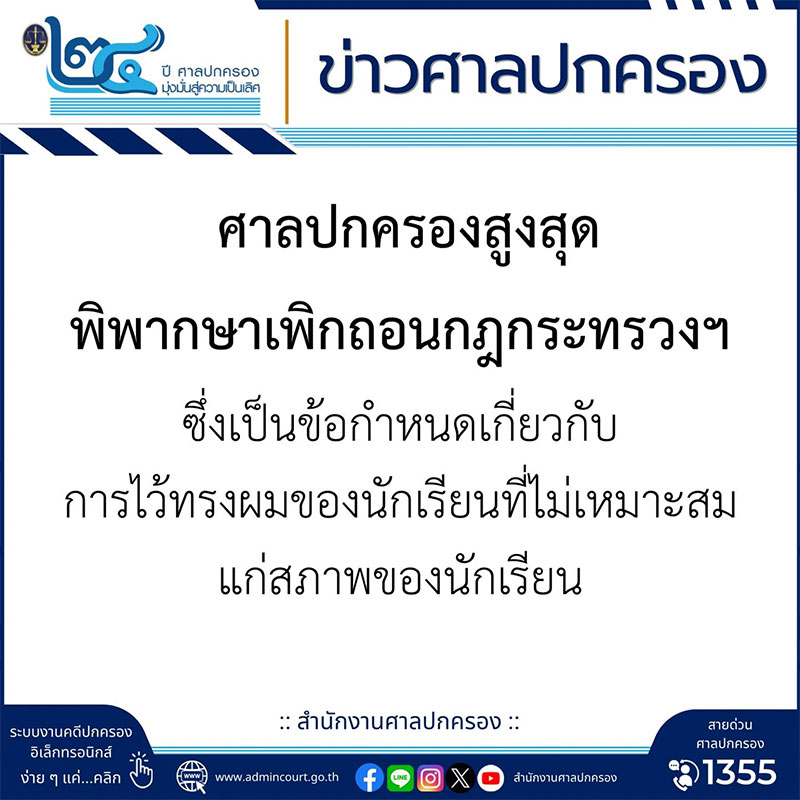
On 5 March 2025, the Supreme Administrative Court adjudicated the revocation of the Ministerial Regulation, which is a requirement on student hairstyles that are inappropriate for the student's condition, as follows:
The Supreme Administrative Court ruled in Case No. SR 24-2020.Revoke Ministerial Regulation No. 2 (1975)Issued in accordance with the announcement of the Revolutionary Council No. 132, which is a requirement on student hairstyles that are inappropriate for the student's condition.
The Supreme Administrative Court held that Ministerial Regulation No. 2 (1975) was issued pursuant to the Notification of the Revolutionary Council No. 132 of 22 April 1972, which stipulated that the following dress and conduct were considered inappropriate for the condition of the student: the male student cut his hair or had long hair on his side and resisted long hair on his back; the female student had a haircut or had a beard; the female student had long hair on his neck; if any school or educational institution allowed the hair to be longer than that, the student used cosmetics or fakes for beauty purposes.It is important to define prohibitions on hairstyles and the use of cosmetics by students from elementary school to secondary school. In this case, it can be considered as a rule that restricts the freedom of the body of a person with student status.
The announcement of the Revolutionary Council No. 132 dated 22 April 1972, which was the power base for the enactment of the Ministry, stated that in order for students and students to be youths who are creating qualifications in terms of knowledge, ideas and morality, ready to receive inheritance from adults, being good citizens, useful to the nation in the future, students and students should be trained and closely supervised by parents, parents and teachers to be good children of parents, good students of teachers, in standing ovation, instruction, includingwithin the rules, traditions and laws of the country
When the Children Protection Act B.E. 2546 was promulgated, it appeared that the principles and reasons for promulgating this Act were announced by the Revolutionary Council No. 132 dated 22 April B.E. 2515. The essence and details of how to support, protect the welfare and promote child conduct are not appropriate for the current situation. Section 22 paragraph one of the Act provides that the treatment of children in any case shall take into account the interests of children. Section 12 paragraph one (1)The Statute prohibits any person from committing acts of abuse against the child's body or mind, and the Ministerial Regulations set out guidelines for determining whether an act is in the best interests of the child or is unjustly discriminatory against the child. 2006 stipulates that acts in the best interests of the child should consider: (1) the individual characteristics of each child; (2) the suitability, needs and needs of the child.
The Supreme Administrative Court held that the spirit of Revolutionary Council Proclamation No. 132 of 22 April 1972 and Ministerial Regulation No. 2 (1975) of 6 January 1975, which established a prohibition for students on hairstyles and the use of instruments, stated the purpose of creating good citizenship for the benefit of the nation, being a good child of parents, being a good disciple of teachers, by requiring them to be in the teaching orders and testimonies of adults and traditional regulations, regardless of social conditions. changedand the development of adulthood and the image of children at each age from the young age 6-7 years of age until adolescence, 13-16 years of age, with student status within the aforementioned ministerial regulations.
In such cases, it cannot be considered that the announcement of the Revolutionary Council and the disputed Ministerial Regulations are rules with the best interest in mind. of the child is important and alsoDisputed rules may be enforced so strictly that they have a detrimental effect on the child's psyche. with a variety of gender identities. อันเป็นการขัดกับหลักการและบทบัญญัติแห่งพระราชบัญญัติ คุ้มครองเด็ก พ.ศ.2546 จึงต้องถือว่าเป็นกฎที่ถูกยกเลิกไปโดยมาตรา 3 แห่งพระราชบัญญัติ คุ้มครองเด็ก พ.ศ.2546 เนื่องจากมีเจตนารมณ์ที่ขัดกับหลักการและบทบัญญัติมาตรา 22 วรรรคหนึ่ง แห่งพระราชบัญญัติดังกล่าว
In addition, pursuant to Section 64 of the same Act, it is determined that the student and Students must behave in accordance with the regulations of the school or institution and the Minister of Education. The Ministerial Regulations on the Conduct of Students and Students B.E. 2548 (2005) was amended. In 2019, although there are no specific requirements regarding student hairstyles, the school Alternatively, the school may establish rules regarding student hairstyles as a subcomponent of the requirements. About the dress codeby considering in accordance with the principles in the best interests of the child and taking into account Developing appropriate appearance and personality according to the age range of students.
combined with when considering The content of the disputed Ministerial Regulation which defines the hairstyles of students, regardless of their development. of the personality of the child at different ages and the variety of sexual characteristics of the person, thus affecting the Restriction on the body performance of persons beyond reasonable cause, which cannot be done under Article 26 of the First Amendment of the Constitution of the Kingdom of Thailand stipulating that the enactment of laws that have the effect of limiting the rights or freedoms of A person shall not increase the burden or limit the rights or freedoms of the Company beyond reasonable cause and shall affect its dignity.The humanity of a person is not such a ministerial regulation as to be contrary to or contrary to the Constitution.
Sentencing to revoke Ministerial Regulation No. 2 (1975) dated 6 January 1975, Oxdam Notification of the Revolutionary Council No. 132 dated 22 April 1975 from the date of the Supreme Administrative Court Verdict