
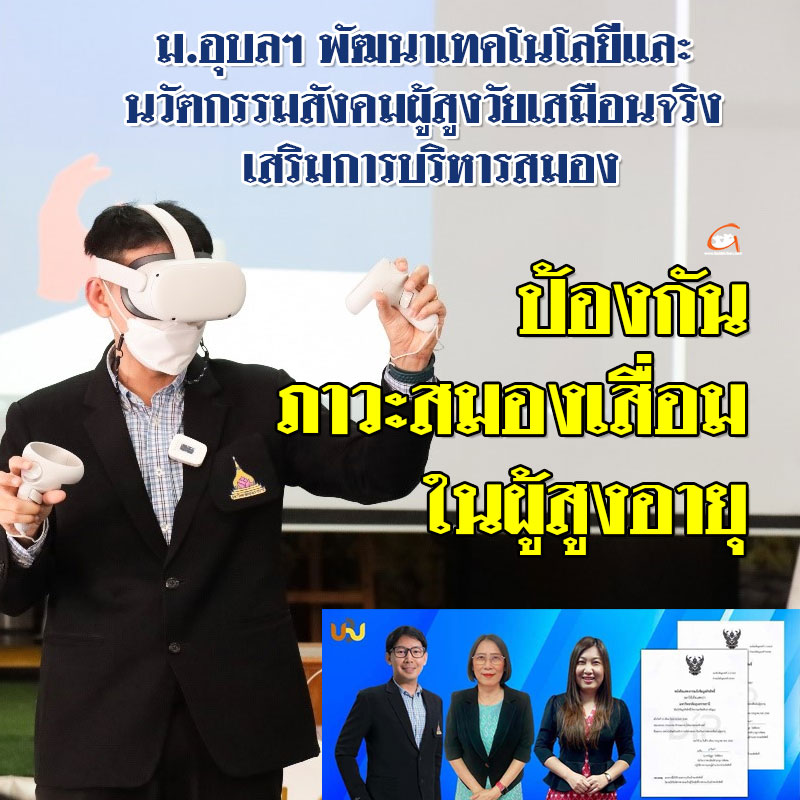
Ubon Ratchathani University, led by Assistant Professor Savitree Singhad and Assistant Professor Suladee Kittiworawet from the Faculty of Nursing, and Assistant Professor Dr. Athipong Suriya from the Faculty of Engineering, are the researchers and creators of the invention and innovation "Development of Technology and Innovation for the Elderly: Virtual Reality and Augmented Reality Technology for Brain Management and Prevention of Dementia in the Elderly."

Technology to create an interaction between the elderly and a computer system that simulates a three-dimensional virtual environment and rotates around 360 degrees. Virtual Reality and Augmented Reality are nursing technologies and innovations developed for use in enhancing the health and prevention of senile dementia and for teaching and learning to promote nursing education in the 21st century.The aim is to develop learners' knowledge and skills in using technology and applying modern learning media, promoting and enhancing their learning so they can apply their knowledge in nursing to promote and prevent dementia in the elderly.

Assistant Professor Savitree SinghaAccording to the Faculty of Nursing along with the Faculty, virtual and augmented reality technology games are characterized by inventions, values, creations, technologies and innovations that are significantly different from conventional brain management games, developed in a modern form of playing digital technology games through the social world, enhance the learning experience in a new way, attract attention, effectively promote interaction with others, and fit the context of the elderly.By integrating geriatric nursing theory with visual and spatial cognitive memory theory and the concept of neurobics exercise, this virtual reality game aims to develop cognitive skills, promote memory, exercise the brain, and prevent dementia in the elderly.
1) Virtual goods game
2) A virtual color touch game, and...
3) Virtual Math Shooting Game

Virtual reality (VR) is a technology that creates interactive communication between the elderly and a computer system that simulates a three-dimensional virtual environment that can rotate 360 degrees. The elderly can interact with the simulated place or environment through virtual reality devices, such as the Oculus Quest 2 VR headset. This allows the elderly to feel as if they are actually in the simulated environment, perceiving and hearing the simulated images and sounds through the virtual reality system, and enabling communication.Do boundless activity and interaction in a digital world that unites objects around you and your environment.

Virtual technology games and augmented reality technology games train the brain in relation to the perception of the five senses to work together by encouraging older people to do learning activities on the tablet. Smartphones, application programs, virtual technology and augmented reality technology are new activities that have never been done. This training of the brain is often like training the brain to work in harmony with each other, making the brain system strong because when practicing brain exercises often.The brain secretes substances called neurotrophins that cause cells, especially in the area of “dendrites” that connect neurons to work better, thus contributing to the growth of cell tissue and healthy brain cells. When the brain cells are healthy, they cause “putative”, meaning memory, concentration, cognition that causes expressive behavior, as well as “high-level brain function”, namely, problem-solving thinking or making decisions and better planning, encouraging older people to use memory refresher thinking.causing the brain to develop continuously, allowing brain function to remain effective, strong and slow down deterioration, enhancing brain performance as well as physical exercise. In order to keep the body healthy, the brain needs exercise to keep the brain healthy as well, which can prevent or slow down dementia in the elderly.

Augmented reality games include:
1) Virtual Color Matching GamesThis game trains analytical and logical thinking, stimulating the brain to think quickly and causing both the left and right hemispheres of the brain to work together in a coordinated manner.
2) Virtual matching gamesThis game helps improve memory, stimulates imagination and creativity, promotes systematic thinking, enhances coordination between the left and right hemispheres of the brain, and regularly using both hemispheres leads to improved memory performance.
3) A virtual addition game.and
4) Virtual Number MultiplicationIt is a simple math problem calculation game. Use mathematical techniques and process skills to add numbers and multiply numbers. It promotes memory skills, observation, concentration, and thinking skills. It improves brain performance.
Augmented Reality games stimulate the cognition of older people by combining Real World technology with Virtual World in real time, which will be seen as a three-dimensional virtual image appearing in the real world via a connected device on a smartphone. Combined with the work process of computers and software to display a three-dimensional image through the digital camera of a tablet smartphone.
The three-dimensional virtual images created by the elderly can be seen and experienced in 360 degrees in real time. Both in animation, soundtrack, and still images, as well as in various forms of Digital Multimedia, can interact with the elderly virtually. With brain management training games, cognitive abilities are stimulated through the five senses to work together to receive information and transmit sensory currents to the brain in different parts of the brain.Improves cognitive skills, promotes memory, concentration, and intelligence, allowing the brain to develop continuously, allowing brain function to remain effective, strong, and slow down deterioration, enhancing brain performance, which can prevent or slow down dementia in the elderly.

For inventions and innovations "Technology development and innovation for the aging society Virtual reality and augmented reality technology Brain management to prevent dementia in the elderly" is another work that made a reputation and pride for Ubon Ratchathani University that has been selected to present its work in the group of inventions for the aging society and the quality of life of Thai people 4.0 by leading to the use of commercial uses for the development of inventions.Model products in the area of innovation, learning media, brain management, memory promotion, prevention of dementia in the elderly. Received an invention patent from the Department of Intellectual Property No. 17431. It is a certified work of innovation, Ubon Ratchathani University, fiscal year 2021, and in the area of virtual reality and augmented reality technology. Brain management, prevention of dementia in the elderly, has been registered for intellectual property.Type of copyright from the Department of Intellectual Property No. 430360 and No. 430358 in academic applications for teaching, promoting and improving learners' learning from innovative technologies that allow learners to be creative, develop skills in nursing for the elderly, learn from real-world situations in teaching and demonstrating technology and brain management innovations, prevent dementia in the elderly, and develop socially effective learning.Utilization in the transfer of knowledge, technology, innovation, academic services to society to the target group, extension, as an applied model for health enhancement and prevention of dementia, and improving the quality of life of the elderly in the community, elderly clubs, and in hospitals and network agencies.
Thipwan Veluwanathorn
Public Relations Specialist, Ubon University